










Converting measurements between metric and imperial systems is a common task in daily life, especially when dealing with construction, crafts, or personal projects. One measurement that often requires conversion is 36mm to inches. Understanding how to convert millimeters to inches accurately can save time, prevent errors, and make it easier to work with tools, blueprints, or product specifications that use different measurement systems. Whether you are shopping for watches, measuring materials for a DIY project, or comparing technical specifications, knowing how to convert 36mm to inches is essential. The conversion process, practical applications, common mistakes to avoid, and tips for ensuring accuracy in all scenarios requiring metric-to-imperial conversions.
Understanding Millimeters and Inches
Millimeters and inches are units of length used in different measurement systems. Millimeters are part of the metric system, which is widely used internationally, while inches belong to the imperial system, commonly used in the United States. One millimeter represents one-thousandth of a meter, making it a very precise unit for small measurements. Inches, on the other hand, are larger and often used for everyday items such as screens, furniture, or hardware. Understanding the relationship between these units is crucial for accurate conversions. The standard formula for converting millimeters to inches involves dividing the millimeter value by 25.4, since one inch equals 25.4 millimeters. This provides a precise method to convert any millimeter measurement into its inch equivalent, including 36mm.
Converting 36mm to Inches
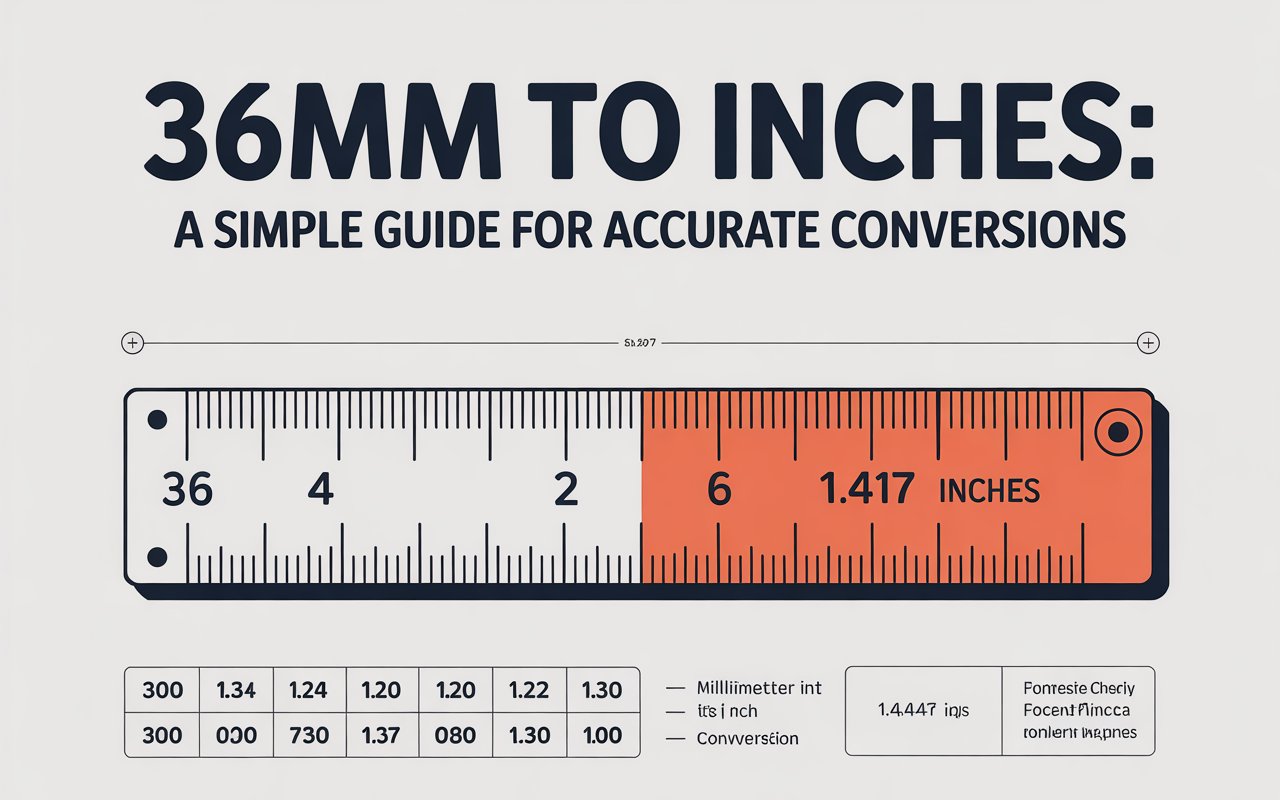
To convert 36mm to inches, you use the standard conversion factor of 25.4 millimeters per inch. By dividing 36 by 25.4, you get the equivalent measurement in inches. Performing the calculation: 36 ÷ 25.4 = 1.417 inches. Therefore, 36mm is approximately 1.417 inches. This decimal measurement is useful for technical work where precise dimensions are required. For more general applications, rounding to 1.42 inches may be acceptable. Understanding this conversion allows you to work seamlessly with products or designs that use different measurement standards. It also helps prevent mistakes when ordering materials or evaluating specifications that may be listed in millimeters or inches.
Practical Applications of 36mm to Inches
The conversion of 36mm to inches has practical uses in a variety of fields. In watchmaking, for instance, the diameter of a watch case is often specified in millimeters, and converting to inches helps consumers understand its size relative to other watches. In construction and DIY projects, measurements of small parts like screws, bolts, or pipes may be listed in millimeters, and converting to inches ensures compatibility with tools or fittings. Even in fashion and jewelry, accurately converting 36mm to inches helps with sizing rings, bracelets, or other accessories. Understanding this conversion improves accuracy, efficiency, and clarity in projects that mix metric and imperial systems.
Common Mistakes in Conversion
While converting 36mm to inches is straightforward, common mistakes can occur if the correct conversion factor is not applied. Some people mistakenly use approximate values like 2.5 or 2.54, which can introduce small errors in precision work. Others forget to round properly when necessary, leading to measurements that are slightly off for manufacturing or DIY projects. Confusing inches with feet or millimeters with centimeters is another frequent error. Awareness of these common mistakes helps ensure that the conversion of 36mm to inches is accurate and reliable. Using a calculator or trusted conversion tool can reduce the risk of errors and provide consistent results.
Tips for Accurate Measurement Conversion
To ensure accurate conversions from 36mm to inches or any other metric measurement, always use the exact conversion factor of 25.4 millimeters per inch. Double-check your calculations, especially in projects that require precise dimensions. When rounding, consider the tolerance of your application—some tasks require precision to the thousandth of an inch, while others are more flexible. Keeping a conversion chart or using a reliable online tool can speed up the process and reduce errors. Additionally, understanding the context in which the measurement is used will help determine whether an exact decimal or a rounded figure is more appropriate.
Tools and Resources for Conversions
Several tools and resources make converting 36mm to inches easier. Online calculators and mobile apps allow instant conversion by entering the millimeter value and receiving the inch equivalent. Spreadsheet programs like Excel or Google Sheets can also perform these calculations quickly with built-in formulas. For manual work, printed conversion charts provide a handy reference without needing electronic devices. Using these resources ensures efficiency, reduces the likelihood of errors, and provides a reliable way to handle multiple measurements across projects. Familiarity with these tools is especially valuable for engineers, designers, and DIY enthusiasts who frequently work between metric and imperial systems.
Conclusion
Converting 36mm to inches is a simple yet essential skill for accurate measurement in various fields. By understanding the relationship between millimeters and inches, applying the correct conversion factor, and using tools effectively, you can ensure precise results in projects ranging from watch sizing to construction and design. Proper knowledge of this conversion helps avoid mistakes, enhances clarity, and allows for seamless integration between metric and imperial measurements.